For Policy Institutes & Think Tanks
Why The Google Ad Grant Is Built For Think Tanks & Policy Institutes
A think tank's work lives in what it publishes. Research, commentary, events, and programs all need readers, and the people you want to reach are already searching for the issues you work on, the news of the day, and the countries and people in it. The Google Ad Grant runs on search, so it can put your work in front of those people without a paid media budget.
Here is the practical version: the Grant gives you up to $10,000 per month in free Google search ads, and Grants Pro accounts like the one we manage for a global policy network go up to $40,000. That is enough to keep your newest research, your newsletter, your events, and your programs in front of people who are actively searching, every day of the month.
Campaigns We Run For Think Tanks & Policy Institutes
There are four campaign types we lean on. Each one reaches a different group of people and tracks a different conversion.
- Brand and reputation campaigns. People search for who you are and what you do, often right after you appear in the news. Google autosuggest shows which of those questions are real, and we make sure your own answer is the one they find.
- Topic and research campaigns. Ad groups built around the issues you publish on, each sending people to the piece that answers the search.
- News campaigns. Broader searches for news about a region, a topic, or a person in the headlines. In a paid account these would be too loose to justify. In a grant account they reach the curious, informed readers a think tank wants.
- Fresh content campaigns. A campaign that serves your newest pieces soon after they are published and lets older ones drop out, alongside dedicated ad groups for the topics that stay in the news.
What Think Tanks Get Wrong With The Grant
These are the three problems we look for first:
- Conversion tracking that cannot keep up with publishing. If every new report or podcast needs its own conversion event, tracking falls behind and the account loses the signal it needs to scale. We set up conversions that fire on any new resource form, so tracking grows with your library.
- Not enough conversions for Google to learn from. Readers of news and research rarely fill out a form on their first visit, so a content account can stall. An engagement conversion, a visitor who stays on a page for 60 seconds and scrolls most of the way down, shows Google who actually reads. It is not a goal on its own, but it gives the bidding enough signal to scale.
- Excluding places where you are in the news. When coverage turns negative somewhere, the instinct is to stop showing ads there. We usually do the opposite, because that is where people are searching for what you actually do.
How A Global Policy Network Did It
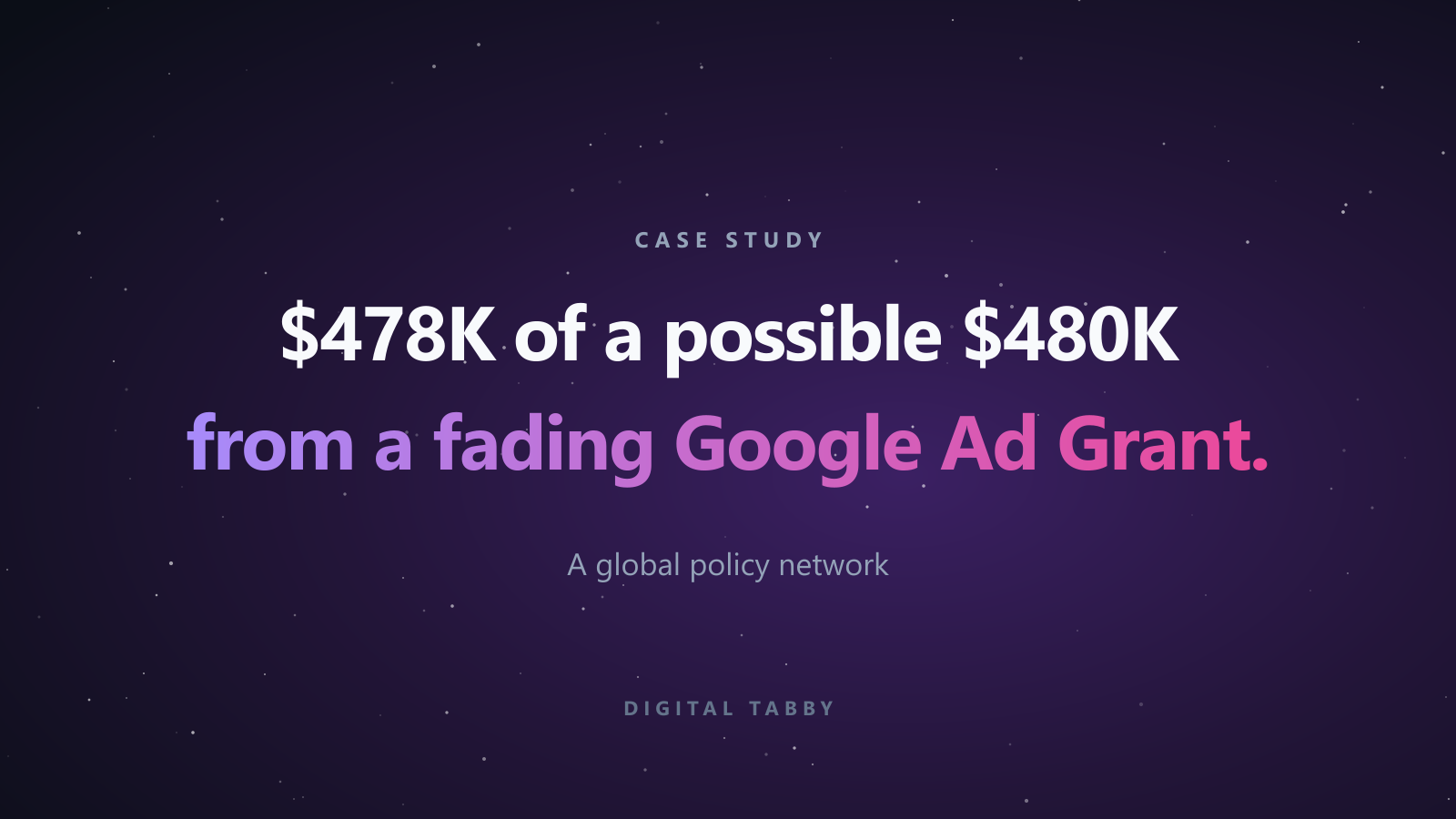
This nonprofit connects think tanks and policy organizations around the world, and publishes a steady stream of articles on what is happening in the countries where its partners work. Its Google Ad Grants Pro account has a $40,000 monthly cap, but in 2024 it used $225K of the $480K available and slid toward zero by December.
We rebuilt conversion tracking around what matters to the network, from resource downloads and donation clicks to event clicks, applications, contact forms, and newsletter sign-ups. We built new campaigns alongside the old ones so spend never dropped while we switched over, cast a wide net to find the news searches people already make, like what is happening in Europe, and gave those topics their own ad groups. When spend stalled in spring 2025, an engagement conversion gave Google enough to learn from. The account reached the cap in August 2025, and from November 2025 through October 2026 it used $478K of a possible $480K, with 162 form submissions since April 2026.
The full breakdown is in the policy network case study.
When To Pair The Grant With Paid Ads
The Grant is incredible, but it has limits. Search-only placements, a bid cap that struggles with competitive keywords, and no Display or YouTube in standard campaigns. When a policy organization is ready for more, the next step is usually Meta ads to grow the audience for new research, and paid Google Ads for events and the competitive searches the Grant cannot win.
You do not need all three at once. We will tell you which channel to add next based on what your organization is trying to accomplish in the next 90 days, not on what would generate the largest retainer.