Are Google Ad Grants Worth It?
Google Ad Grants are a powerful, but often misunderstood, tool in the world of nonprofit marketing. The appeal of a free $10,000 a month in advertising on the world’s largest search engine seems amazing, and it is.
But you have to actually know how to use Google Ads to access the money.
Countless nonprofits have gone through the application process, logged into their account and tried to run ads only to be met with crickets. Other nonprofits have probably heard how the various rules, regulations and limits from Google make the accounts useless.
So what’s the truth and are Google Ad Grants worth it or are they a waste of time?
For the majority of nonprofits, Google Ad Grants are well worth the effort. If your nonprofit’s audience uses Google and you have information or services to share then there’s a way to make the Google Ad Grant work for you.
However, some nonprofits will have an easier time than others maximizing and getting great results from the grant.
We’ll take a closer look at which nonprofits are set up to have the best results along with everything else you need to know.
Let’s get started!
What is a Google Ad Grant?
The Google Ad Grant is $10,000 per month of free Google Search advertising that Google gives to eligible nonprofits. It is not a cash grant. It is ad credit that runs on the same Google Ads platform paid advertisers use.
Whether the grant is “worth it” depends entirely on what you do with it and how the rest of your digital presence is set up.
What Does “Free $10,000 In Google Ads” Really Mean?
The Google Ad Grant is an in-kind advertising program that offers nonprofits $10,000 a month for search ads. Google Ad Grant accounts are unable to advertise on YouTube, Display, Gmail and other channels, because the grant is search only. That means you won’t have access to YouTube ads, banner ads on other websites, or shopping campaigns. Performance Max is now available in grant accounts too, but in a grant account it still only shows on search.
This quick video explains exactly what this means with examples of where ads show in both Google Search and Google Maps:
The case that the grant IS worth it
For most nonprofits, the answer is yes. Here’s why:
- It is free. There is no cost to apply, no cost to maintain, and no cost to use the ad credit. The only investment is the time (or agency fee) to set it up and run it well.
- It puts you in front of high-intent searches. People actively searching for terms related to your cause are the warmest possible audience.
- It scales over time. Once a nonprofit account is mature, $10,000 in monthly ad spend can translate into thousands of website visitors, donor leads, volunteer signups, and program inquiries.
What Do Real Google Ad Grant Results Look Like?
The most honest answer to “is it worth it?” is what happens in real accounts. Here are three nonprofits we manage the grant for today:
- A large nonprofit with a museum function spent $1,051 of its grant across all of 2023 and got zero conversions for it. Within two weeks of our launch the account was hitting its daily max, and over the next 12 months it used $129,265 of the grant and brought in $5,746 in ticket sales. Read the museum case study.
- Austin Pets Alive! had an active grant trending around $3,500 a month, about a third of what was available. Within 90 days it was above the $10,000 cap, and it has used 99% or more of the grant every month since: $132,034 in 12 months, $4,549 in donations in a single month, and 7,609 adoption applications. Read the Austin Pets Alive! case study.
- A large public radio nonprofit was stuck at about $3,440 a month. Six months after we took over it was at the grant cap, and the grant has raised $32,888 in donations in 2026 alone. Read the public radio case study.
All three already had the grant before we started. The $10,000 didn’t change, how the account was run did. You can see all of our Google Ad Grant case studies here.
The case that the grant is NOT worth it (for some)
The grant is not the right fit for every nonprofit. The two main reasons:
- Very narrow local focus. If your nonprofit only serves a single small city or town, the search volume in your area may be too low to spend a meaningful portion of the $10k.
- No clear conversion path. If your website does not have clear actions for visitors (donate, sign up, learn about a program), the traffic from the grant won’t translate to outcomes. The grant amplifies what is already there; it does not fix a broken funnel.
Google Ad Grant Limitations
Grant ads only get a chance to appear in search results after paid ads have had a chance. In other words, the Google Ad Grant is using remaining ad inventory.
This means that revenue-generating keywords will rarely get traction in a grant account since paid ads will take all the available spots.
For example, let’s say your nonprofit is an animal shelter and you want to show up for “donate for animals”. It’s very unlikely that there will be space for grant accounts to show since paid accounts will be happy to bid on this valuable keyword.
Instead, you’ll often need to get more creative and consider keywords that could have a similar outcome (in this case donating) but a much less obvious intent. Paid accounts will be unlikely to target these keywords since the conversion rates will be lower.
For example, you could target the keyword “how to help animals”. The intent behind that search is much less clear and the person searching could be interested in volunteering, signing a petition, adopting, and of course making a donation.
You can see this in practice simply by completing a search for “donate for animals” and then “how to help animals”. Notice how the first search (high-intent and revenue generating) likely has 4 ads every time while the second search (lower intent) has zero or 1 to 2 ads.
This video explains the dual auction concept in more detail:
However, you’re not always having to make compromises to dodge paid accounts and there are more than 8.5 billion Google searches every single day with plenty of room for everyone. Keywords related very specifically to nonprofits (like animal adoption, volunteering, etc.) will typically have less paid competition and plenty of room for grant accounts to get traction.
Are There Hidden Costs?
The Google Ad Grant is completely free, but like any marketing channel, it requires some investment (either time or money) to use effectively.
You’ll need to learn the Google Ads platform and set up proper tracking to measure results. This includes understanding how to complete keyword research, write compelling ads, structure your account, and much more. Along with how to use Google Analytics 4 for conversion tracking. The initial learning curve takes some time, especially if you’re unfamiliar with digital marketing platforms overall.
However, there is Google Ad Grant training available that will take you from complete novice to a maximized grant account but it will still take time to learn.
On the other hand, you may find it makes more sense to work with an agency that specializes in Google Ad Grant management and Google Ad Grant agencies typically charge $400-$1,500 monthly for full management. When you consider this cost against managing $10,000 in free advertising, many nonprofits find the ROI makes sense and we’ll talk in more detail about ROI later in this article.
There’s no right or wrong choice here. It depends on your team’s capacity, interests, and other priorities. Both DIY and agency-managed accounts can be very successful with the right approach.
Which Nonprofits Have The Best Results With Google Ad Grants?
There are two big factors, and you typically (but not always) need one or the other to have the best results: broad geographic targeting and multiple offers.
Advantage One: Broad Geographic Targeting
Nonprofits that are national or international have an easier time maximizing the grant because the larger the geographic area, the more people are searching. Said another way, if you’re only able to target the 5 mile radius around your nonprofit then there are only so many searches available for you to target.
But if you’re able to target the entire country, or multiple countries, now you have many more searches available for your nonprofit to target.
Advantage Two: Multiple Offers
Nonprofits that have multiple offers, services, types of content, or different ways for their audience to interact with them also have an easier time maximizing the grant.
Because they have various programs, these organizations can target more keywords and create more opportunities to show up in search while avoiding paid accounts.
I want to emphasize that content is included as an “offer” and since we’re talking about Google search that’s typically in the form of written content. The more content you have, the more keywords you have to target and drive traffic to your website via grant.
From there, your marketing plan should include some way of “capturing” that traffic so that you can nurture them over time but content is the starting point.
While you may not have an option to change your location targets or your audience, you can produce content which makes this the one advantage that you have the most control over.
Advantage Three: General Audiences
Nonprofits that have a very niche or small audience that they want to reach will have a harder time. For example, if you only want to reach actively employed chemists for your professional association nonprofit, you immediately have a much smaller set of search volume to work with.
Again, this isn’t impossible and we helped the Washington DC Economic Partnership reach business owners interested in relocating to DC using the Google Ad Grant (see their case study here) which is certainly a niche audience. It’s possible, but it will make things more difficult.
Real World Examples
For an example of each, let’s look at Goodwill and HeroBox.
Goodwill locations service specific regions but they have a wide range of offers or entry points into the organization. They offer thrift store shopping, in-kind donation opportunities, workforce advancement programs, community enrichment and much more. Every one of these offers has its own set of dozens of keywords that Goodwill can target.
If one has too much paid competition they have plenty more directions they can go so that Goodwill locations typically have a very easy time maximizing their grant.
HeroBox, on the other hand, is a military nonprofit with just one offer: helping people send care packages to deployed military. While they don’t have multiple offers, they are able to target the entire country which allowed them to achieve excellent results from their Google Ad Grant (see their case study here).
The more advantages you have, the easier time you’ll have maximizing the grant and the reverse is also true.
Multiple Ways To Maximize Your Grant
These are general guidelines and not requirements for maximizing your grant. We’ve been able to successfully maximize the grant for nonprofits with just one offer and one narrow geographic location (like Cat Care Society among others).
There are also many other factors like your specific offer, specific location, and what you consider to be success for your nonprofit. Instead of set-in-stone rules, consider these guidelines to help you understand how easily you’ll be able to maximize your Google Ad Grant.
If you want to learn more about what could be possible with the grant for your organization, you can schedule a call here and we’ll help you understand your specific path to maximizing the grant.
How To Calculate Your Nonprofit’s ROI
Every marketing plan should have a clear ROI but with the Google Ad Grant it’s not always so straightforward.
There’s a temptation to predict the return on investment using the expected cost-per-click (CPC) and while this can be a valid starting point, the gap between Google’s keyword planner tool and the actual cost per click can often times be massive which will immediately throw off any projections.
The issue with using CPC is that it’s your cost per conversion that really matters.
Instead, I suggest working backward from your actual investment in the Google Ad Grant, either in the form of time or management fees, and then determine your minimum successful ROI from there.
Said another way, if you’re spending 40 hours to build out your Google Ad Grant or paying $1,000 a month for the work what would make that time or money worth it? How many new volunteers, in-kind donations, newsletter subscribers, sales, event registrations or other conversions are worth $1,000 or 40 hours of staff time?
For some organizations simply generating the traffic, awareness, and sharing information about misunderstood topics could be worth the investment while others will want to see event registrations, adoptions, donations, email subscribers, and any other number of actions.
The grant also offers a basic form of reputation management as you can impact the search results for questions about your nonprofit or control the results for your brand. This too has value that can be difficult to define with a traditional ROI approach.
For an example of what reputation management can look like with the grant, check out this ad that shows up when you search for Many Hopes:
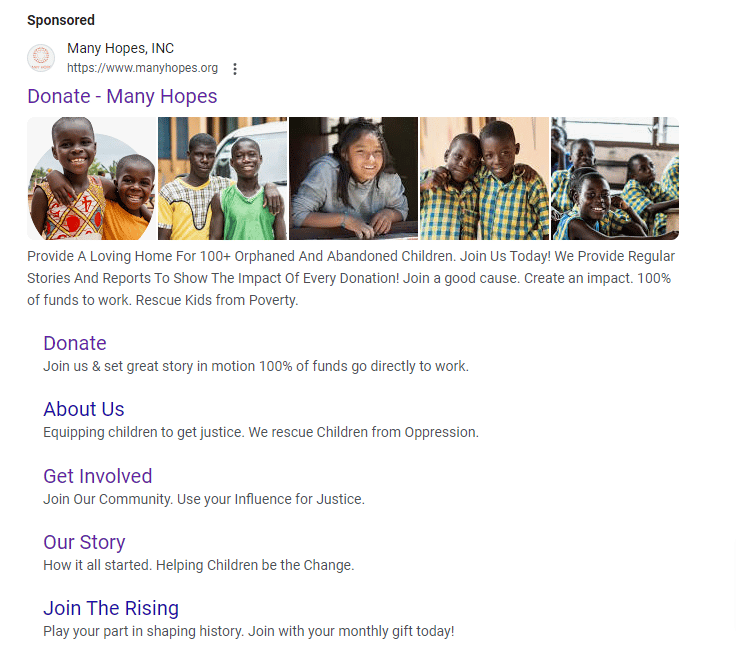
Not only does this ad take up a ton of space in the search results, but Many Hopes gets to control what shows up. The photos, text, links, and more are all managed from within the Google Ads platform and Many Hopes is able to highlight their most important pages and most important actions.
Because Google is covering the ad spend, the real investment is either time or money so start with the real cost and determine your ROI from there.
How to decide
The easiest way to know if the grant is worth the effort for your specific nonprofit is to look at the search volume for your category and audit your website’s conversion paths. If both are healthy, the grant is almost certainly worth it. If one or both are weak, the grant can still help, but you’ll want to fix the underlying issue first.
Either way, getting professional help to set the account up well in the first 90 days is what separates the nonprofits that maximize the grant from the ones that let it sit at 10% utilization for years.
So…Should Your Nonprofit Apply?
The short answer is yes, the majority of nonprofits should apply for the Google Ad Grant.
If your nonprofit is already eligible then the application process can be done in less than 30 minutes of your time which makes the real investment the time or money it takes to utilize and maximize the grant.
But if you have any content or service to share with the world, and your audience uses Google to find it, then there’s a use case for the Google Ad Grant.
If you want to learn more about what’s possible with the grant for your specific organization, book a call with us here. We’ll talk about your specific nonprofit, your goals, and how we’ve helped similar nonprofits maximize their own grant.